Before You Go: The Essentials
Is Albania safe for tourists? Yes — and the question itself reveals the gap between Albania's reputation and its reality. Albania is considerably safer than most Western Europeans assume, has lower petty crime rates than the Mediterranean destinations most people choose over it, and the Albanian Riviera specifically is one of the most relaxed, welcoming environments in southern Europe. The danger profile that still lingers in many guidebooks belongs to the 1990s, not 2026.
That said, safety in Albania isn't unconditional. There are specific things — driving standards, one particular ATM scam, the taxi situation at Tirana airport — that require attention. This guide covers all of them honestly, based on direct experience on the ground.
Low violent crime against tourists, welcoming locals, and an established tourist infrastructure on the Riviera. Main risks are specific and avoidable: taxi overcharging, ATM currency conversion traps, and driving standards on mountain roads.
Crime Rates — What the Data Shows
Albania's crime rate against tourists is low by regional standards. The Global Peace Index 2025 ranks Albania above France, Italy, and the United States in terms of overall peacefulness. Violent crime targeting tourists is extremely rare — there are no travel advisories from UK, US, or EU governments warning against tourist travel to Albania. The FCDO and State Department both rate Albania as "exercise normal precautions," which is the same rating as France, Germany, and Spain.
Petty theft exists, as it does everywhere. Pickpocketing in crowded areas of Tirana's Blloku neighbourhood and on busy beach promenades in summer is the main concern. The usual precautions apply: don't leave valuables visible in cars, use a money belt in busy markets, and be aware in crowded restaurants.
The Riviera Specifically
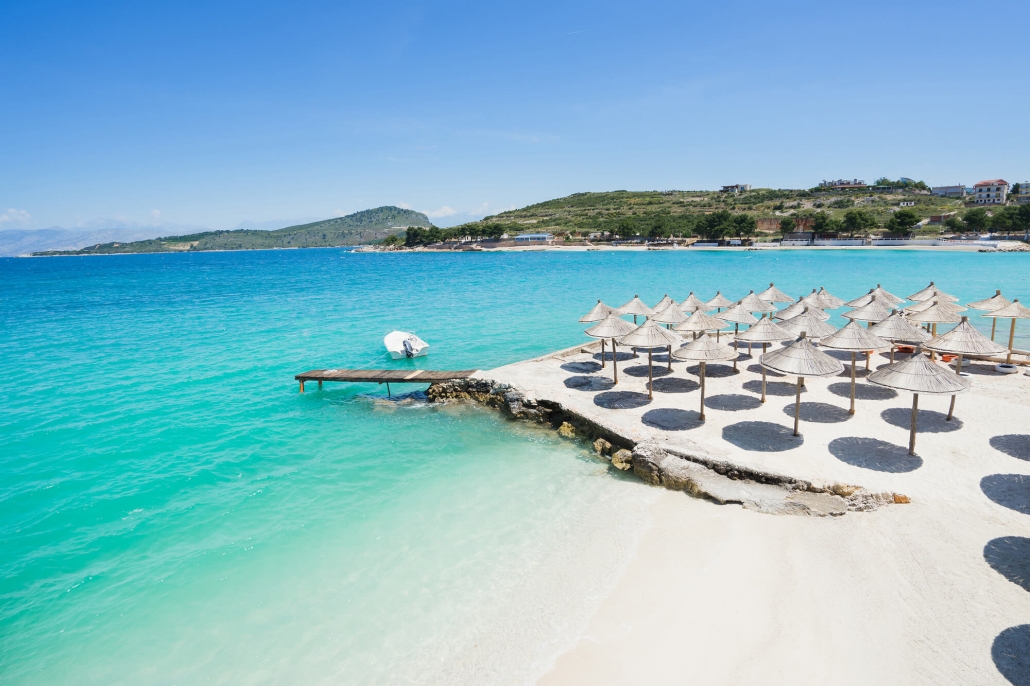
Ksamil, Himara, and Sarandë are resort towns with a predominantly tourist economy. Incidents involving tourists are taken seriously. In three months on the Albanian Riviera across two trips, the worst I encountered personally was a restaurant adding an unrequested dessert to the bill — which was immediately removed when I queried it, with an apology. That is the level of "crime" that most visitors experience.
Solo Female Travel in Albania
Albania is widely considered safe for solo female travellers. The country has a strongly family-oriented culture where lone women are treated with respect rather than as targets. Harassment in the aggressive form seen in some Mediterranean tourist areas is uncommon. The hospitality culture — being invited for coffee, offered directions, asked about your journey with genuine curiosity — is a consistently reported experience for solo female visitors.
Practical considerations: dress modestly when visiting inland villages and religious sites. Shorts and sleeveless tops are fine in the beach resorts but can attract unwanted attention in more conservative rural areas. Avoid walking alone on unlit rural roads at night — not because Albania is uniquely dangerous, but because this is standard common sense in any country.
The Scams You Need to Know About
1. Taxi Overcharging at Tirana Airport
This is the most common issue tourists report in Albania, and it is entirely avoidable. Unofficial taxi drivers at Tirana International Airport will quote prices of €40–€80 for rides that should cost €15–€25. The fix: use the official metered taxis from the designated rank outside arrivals, or pre-book a transfer. Always agree on the price in writing before departing. Using Bolt (which operates in Tirana) eliminates the problem entirely.
2. ATM Dynamic Currency Conversion
Every ATM in Albania will ask if you want to be charged in your home currency rather than Albanian Lek. Always decline. Always choose to be charged in ALL. The "convenience" conversion rate offered is typically 5–8% worse than the real rate — on a €500 cash withdrawal, that's a €25–€40 invisible fee. The ATM will try to make the "convert" button look like the right choice. It isn't.
The underlying fix is to use a zero-fee travel card. Our full guide to money in Albania covers which cards eliminate foreign transaction fees entirely.
3. Metered Taxi Shortchanging
In smaller towns, some taxi drivers quote a price and then claim the fare was higher on arrival. The fix: agree the price before getting in, confirm it clearly, and use Bolt in cities where it's available.
Driving Safety in Albania
This is the most legitimate safety concern for tourists in Albania, and it deserves honest treatment. Driving in Albania requires more concentration and patience than driving in western Europe.
Road quality varies significantly. Urban driving is aggressive. Mountain roads are narrow with steep drops and no barriers on some stretches. Drive defensively, allow 50% more time than GPS estimates on mountain routes, and avoid driving after dark on unfamiliar roads.
The SH8 coastal road — the main artery of the Albanian Riviera from Vlorë to Sarandë — has been significantly upgraded since 2023 and is now in excellent condition. The switchbacks are dramatic but manageable in a standard car. The challenge is other drivers, not the road itself: overtaking on blind corners is common, and speed limits are treated as suggestions.
Our 7-day Albania itinerary includes specific driving time estimates that account for the actual road conditions — budget an hour for a stretch that Google Maps estimates at 35 minutes on any mountain section.
Health and Medical Facilities
Albania has functioning healthcare in the major towns. Sarandë and Himara have clinics capable of handling standard tourist issues — minor injuries, stomach problems, mild heatstroke. Tirana has a full hospital system including private clinics accredited for international visitors.
Rural and remote areas are a different matter. If you're exploring remote coves and unmarked tracks (which you should be), you need comprehensive travel insurance that includes medical evacuation. The nearest serious trauma facility to Ksamil is in either Sarandë (15 min) or Corfu (45 min by ferry) — adequate for most situations, but insurance is not optional.
The Albanian Riviera: Safety in Practice
The specific area most tourists visit — Ksamil, Himara, Sarandë, Butrint — is genuinely safe in the way that a small Italian coastal town is safe: low crime, lots of families, a visible local presence, and an economic incentive to ensure tourists have good experiences. The beach towns have informal security at parking areas and busy beach fronts in high summer.
Unguarded beaches are the one practical concern. Many of the Riviera's best spots are remote, accessed by rough tracks, and have no lifeguards. Strong swimmer or not, be aware of currents — the Ionian Sea has rip currents in specific cove configurations, and the most beautiful beaches are often the ones with no one else around to help if something goes wrong.