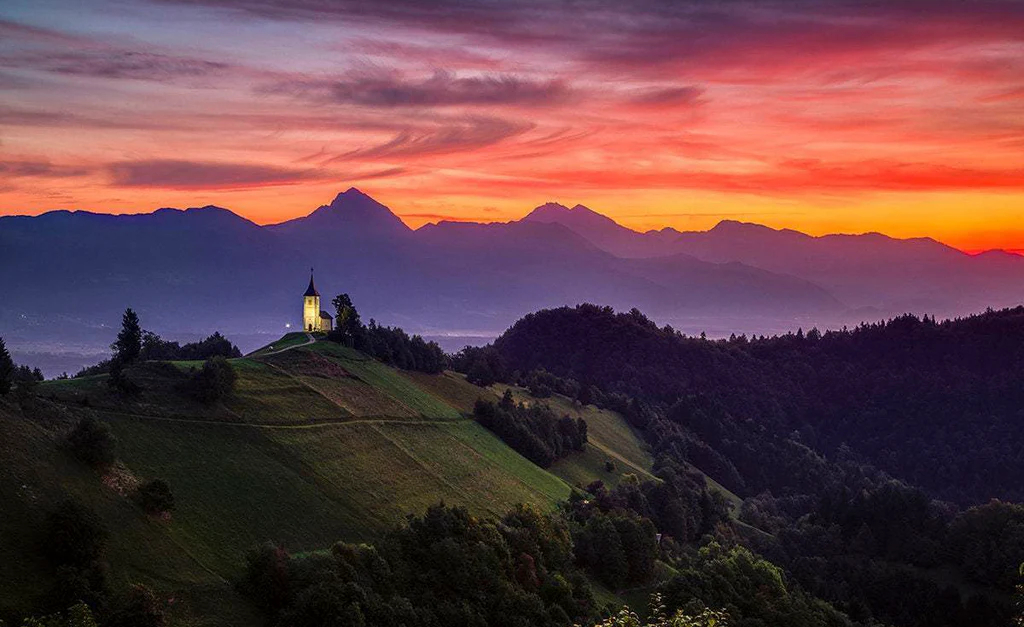
I was standing on the balcony of a hotel room in Slovenia, looking at a view that I have seen on approximately four thousand Instagram posts tagged #SwissAlps. Glacial lake below. Limestone peaks above. Pine forest stretching to the waterline. A church spire in the distance, barely visible through the morning mist. The only difference was that I was paying €118 a night for the room, breakfast was included, and the lake was entirely free to look at — which in Switzerland, where even a roadside viewpoint sometimes comes with a parking meter, feels like a small act of rebellion.
The view was of Lake Bohinj. The hotel was a 4-star property in the village of Ribčev Laz, right at the lake's eastern shore. The mountains behind it are the Julian Alps — the same range that continues west into Italy's Dolomites and shares geological DNA with the Bernese Oberland. They are not smaller, less dramatic, or less beautiful than the Swiss Alps. They are the same mountains. They just happen to be on the other side of a border that nobody has any good reason to respect when it comes to scenery.
Slovenia is the country that travel media discovered in about 2016, declared "the next big thing," and then promptly forgot about while moving on to Georgia and Albania. This is excellent news for you, because what "forgotten" means in practice is that the hotels are still cheap, the trails are still empty, the restaurants still have tables, and the single most extraordinary alpine lake view in central Europe still costs €120 a night rather than €480.
The Hotel: Why It Works at €120
The properties around Lake Bohinj that sit in the €100–€140 range are not cutting corners. They are simply operating in a country where labour costs, food costs, and land values have not yet been inflated by the "Swiss premium" — that invisible surcharge that adds 300% to everything within sight of a Matterhorn poster.
The hotels worth your attention in Ribčev Laz and the neighbouring village of Bohinjska Bistrica fall into two categories. The first is the small, family-run 4-star properties with ten to twenty rooms, often with a restaurant on the ground floor, a terrace facing the lake, and an attention to detail — local wood, Slovenian textiles, properly sourced breakfast — that would be marketed as "boutique luxury" in Switzerland and priced accordingly. In Bohinj, these properties are simply called "hotels," and they cost €110–€140 a night in high season with breakfast.
The second category is the self-catering apartments and guesthouses scattered along the road between Ribčev Laz and the Savica waterfall at the far end of the lake. These start at €60–€80 per night.
For the purposes of this article — and the claim in the headline — I am talking about the first category. A 4-star room with lake views, a proper breakfast spread that includes local honey, fresh bread from the village bakery, and enough cheese and cold cuts to skip lunch. That room is €118–€135 depending on the property and the dates. The same specification in Zermatt: €400–€550. In St. Moritz: €500–€700. In Interlaken, which is the most direct Swiss comparison to Bohinj: €280–€380 for a comparable lake-view room, and the lake — Lake Thun — is, and I say this with genuine respect, not as good.
Lake Bohinj vs. Lake Bled — And Why You Should Skip the Famous One
Most people who go to Slovenia go to Lake Bled. Lake Bled is beautiful. Lake Bled has an island with a church. Lake Bled has a castle on a cliff. Lake Bled also has approximately 8,000 daily visitors in July, a shoreline lined with snack stands selling overpriced cream cake, and a hotel scene that has been carefully optimised to extract maximum revenue from the Instagram traffic.
Lake Bohinj is thirty minutes further into the mountains. It has no island, no castle, no cream cake industry, and roughly one-tenth the visitor numbers. What it has instead is the largest natural lake in Slovenia — a glacial basin carved out during the last ice age, fed by underground springs so clear that from the surface you can see the bottom at twelve metres. The water is a deep, cold blue-green that changes colour with the light and the weather in a way that Lake Bled's more manicured shoreline doesn't quite allow.
If you have three days in Slovenia, do not spend them at Lake Bled. Spend one afternoon there — the island church is worth seeing once — and then drive to Bohinj and check in for two nights. The moment you stand on the shore at Ribčev Laz and look west toward the Savica waterfall end of the lake, with the peaks stacking up behind each other like a layered landscape painting, you will understand why the people who know both lakes never go back to Bled.
The View That Beat Switzerland — And Where to Find It
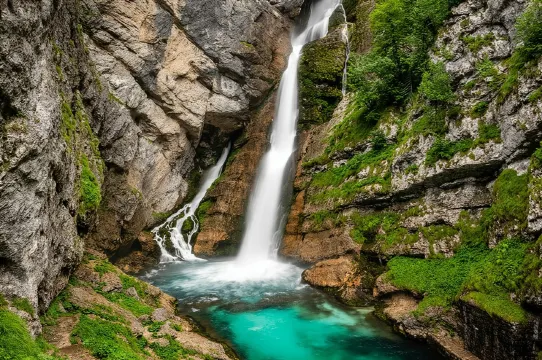
The claim in this article's headline is specific, and I want to be specific about what I mean by it. The view that justifies the comparison is not a single point but a corridor — the western end of Lake Bohinj, where the lake narrows toward the Savica waterfall and the mountains close in on both sides. Stand here at 6am in June and the lake is a mirror. The peaks of the Julian Alps — Vogar, Komna, Bogatin — are reflected in the water with a symmetry that makes it difficult to tell where the land ends and the reflection begins.
I have stood at the viewpoints above Zermatt looking at the Matterhorn. I have taken the train to Jungfraujoch and looked out over the Aletsch Glacier. These are extraordinary experiences and I am not diminishing them. But the view at the western end of Lake Bohinj at dawn is, by the metric that actually matters — the one where you stand still and stop taking photographs because the act of looking has become sufficient — its equal.
The Vogel Cable Car — €18 to the Top of the World
If you want to see the view from above rather than from the lakeside, the Vogel cable car runs from the southern shore of Lake Bohinj up to an altitude of 1,535 metres. The ride takes four minutes. At the top, you are on a wide alpine plateau with panoramic views across the entire Julian Alps, down to Lake Bohinj far below, and west into Italy on a clear day. A similar cable car ascent in Switzerland — the Schilthorn, the Gornergrat railway — costs €50 to €220 per person. The Vogel cable car costs €18 return. The view from the top is not "almost as good." It is the same geology, the same scale, the same drama.
The Food — And Why Slovenian Mountain Cuisine Is Underrated
Slovenian food occupies a strange position in the European culinary hierarchy — it is technically central European, but with Mediterranean and Balkan influences that make it genuinely difficult to categorise and genuinely interesting to eat. In the Bohinj valley, the local cuisine leans heavily on what the mountains provide: freshwater fish from the lake, game from the forests, mushrooms and wild berries from the high meadows, and dairy from the alpine pastures that still operate in the traditional way.
The dish to order is štruklji — rolled dumplings that can be sweet or savoury, filled with cottage cheese, walnuts, tarragon, or apple. In the Bohinj restaurants, a portion costs €6–€9. The other essential is sočni žlikrofi — small filled pasta dumplings from the Soča Valley. At a mountain hut on the Vogel plateau, a plate with mushroom sauce costs roughly €12. At a Swiss mountain restaurant of equivalent altitude, the same dish would be €28–€35.
Slovenia also produces genuinely excellent wine, particularly from the Podravje and Primorska regions. A bottle of quality Slovenian white in a Bohinj restaurant costs €15–€22. The same quality level in a Swiss restaurant would be €40–€60.
The Lake Bled Cream Cake — One Thing to Actually Do in Bled
If you do make the afternoon trip to Lake Bled, the one thing worth the detour is the kremšnita — Bled's famous cream cake. A square of puff pastry, custard filling, and whipped cream that has been made to the same recipe since 1953 at the Café Restaurant Park on the lakefront. It costs €4.50. It is, by any rational measure, just a cream cake. It is also, somehow, one of the best things you will eat in Slovenia.
Ljubljana — The 2-Hour Capital That Deserves a Full Day
Most people treat Ljubljana as a transit point — land at the airport, pick up the car, drive to the mountains. This is a mistake. Ljubljana is one of the most pleasant small capitals in Europe, and it rewards a full day of exploration before you head into the Julian Alps.
The old town is compact, pedestrian-only, and built along the banks of the Ljubljanica River. Cafés line the waterfront. The architecture is a mix of Austrian Habsburg formality and Yugoslav-era brutalism that shouldn't work together but somehow does. The castle sits on a hill above the city, accessible by funicular, and the view from the ramparts across the old town roofs to the mountains beyond is the sort of thing that makes you realise Slovenia's geography is absurdly concentrated — you can see the Alps from a capital city café.

Postojna Cave & Predjama Castle — The Underground Alps
Forty minutes south of Ljubljana, the landscape does something unexpected. The mountains go underground. Postojna Cave is a 24-kilometre karst cave system — the largest in Europe — with stalactites, stalagmites, and underground chambers so vast that they have their own microclimate. You ride through the cave on a miniature electric train, which is both genuinely thrilling and slightly absurd, like a theme park ride designed by geologists.
Ten minutes from the cave, Predjama Castle is built into the mouth of a cave in a cliff face. It is the largest cave castle in the world, and it looks like something from a fantasy novel — a full medieval fortress emerging directly from solid rock. In the 15th century, a knight named Erazem Lueger used the castle as a base for a year-long siege, surviving by being supplied through a secret passage that led through the mountain behind the castle. The passage still exists. You can walk through it.


The Soča Valley — The Emerald River That Makes Lauterbrunnen Feel Overproduced
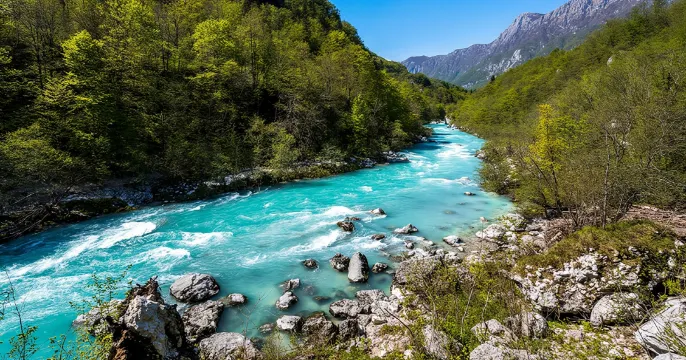
Forty minutes south of Bohinj, the landscape changes character entirely. The Soča River cuts through a deep limestone canyon, and the water — I need to be precise about this — is not blue, not green, not turquoise, but a specific shade of emerald that does not appear to exist anywhere else in nature outside of a jeweller's display case. The river is so clear that from the bank you can see individual stones on the riverbed at depths of five metres.
The valley was the site of the Isonzo Front during World War I — the river formed the front line between Italian and Austro-Hungarian forces for nearly three years. The remnants of the war — trenches, bunkers, a remarkable open-air museum at Kobarid — are woven into a landscape that is simultaneously one of the most beautiful and most historically charged in Europe. Ernest Hemingway wrote about this valley in A Farewell to Arms. He did not exaggerate.
In practical terms, the Soča Valley is where you go for adventure activities — rafting, canyoning, zip-lining, kayaking — or for hiking trails that follow the river through gorges and past waterfalls. The towns of Bovec and Kobarid serve as bases. The food in the Soča region has a distinct Italian influence — you'll find trout from the river, gnocchi, and excellent gelato — that sets it apart from the more central-European cuisine of the Bohinj valley.
Getting There — Flights to Ljubljana
Ljubljana's Jože Pučnik Airport is small, efficient, and surprisingly well-connected. easyJet flies direct from London Gatwick, Luton, and Bristol. Wizz Air serves Ljubljana from multiple European bases. Lufthansa, Air France, and Turkish Airlines provide legacy carrier options with one stop. From most of western Europe, the total travel time is four to six hours.
Return flights from London to Ljubljana in summer typically sit between €120 and €220 if you book six to eight weeks ahead. From Paris or Amsterdam, add €30–€50. From Frankfurt or Munich, you can sometimes find fares under €100 return.
The Honest Part: What Slovenia's Mountains Aren't
Slovenia is not Switzerland, and the Julian Alps are not the Bernese Oberland — though they are close enough in character that the comparison is not absurd. What Slovenia lacks is the infrastructure of extreme altitude. There is no Jungfraujoch equivalent — no railway tunnel drilled through a mountain to a 3,454-metre observation deck. The highest accessible point by cable car in the Julian Alps is around 1,800 metres, which is magnificent but not the same as standing on top of Europe with an oxygen bar and a gift shop.
The hotel quality in Bohinj is consistently good but not consistently luxurious in the way that a Swiss 4-star guarantees a specific set of amenities. Some properties have spas. Most don't. Restaurant service can be unhurried in a way that a Swiss-trained reader might interpret as slow rather than relaxed. The weather in the Julian Alps is genuinely unpredictable — I had a day in June where it was 26°C and sunny at 9am and 14°C with horizontal rain by 2pm.
What Slovenia's mountains are, very specifically, is this: the same geological spectacle as the Swiss Alps, experienced in a way that still feels personal rather than managed, at a price that allows you to stay longer, eat better, and drive home without the particular financial regret that accompanies a week in Verbier.
The Real Price Comparison
Three nights in the Slovenian Alps costs one-third of three nights in the Swiss Alps. The room has the same view. The food is arguably better. The mountains are the same mountains. The only thing missing is the bill shock at checkout.