Santorini is a mathematical equation disguised as a vacation. You pay €500 a night for a cave room with a private terrace that you won't use because you are too tired from navigating crowds. You pay €30 for a coffee to look at a caldera that you could look at for free if you stood on a different cliff. You pay a premium for a brand.
I ran the numbers for a 4-night trip to Santorini in July 2026. Then I ran the exact same itinerary—same duration, same level of aesthetic quality, same Mediterranean luxury—on the island of Milos. The difference was $1,412. Milos is what Santorini was before the algorithm found it: geologically surreal, visually pristine, and aggressively unconcerned with your Instagram following.
Why Milos is the "Old" Santorini
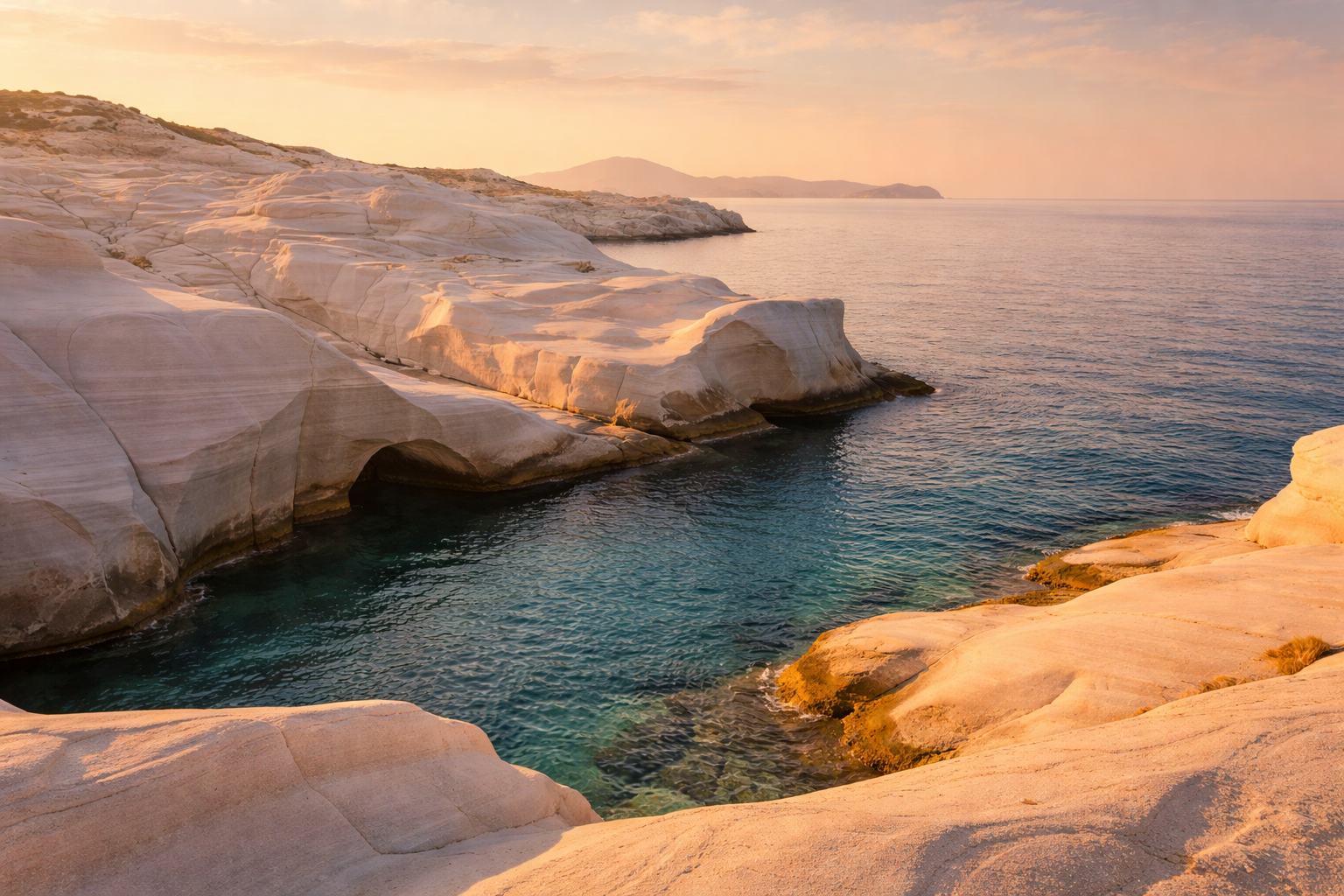
Santorini's visual appeal comes from its volcanic geology—the white-washed buildings contrasting with the black rock and the deep blue sea. Milos has the exact same volcanic DNA. It is the island where the Venus de Milo was discovered. Its coastline is a fractal of hidden coves, sea caves, and impossible rock formations.
But unlike Santorini, where every inch of cliffside has been monetized, Milos feels like a place where geology is still the main attraction. The villages are low-slung and colorful, particularly Klima, where fishermen's houses are painted in bright pastels and sit directly on the water's edge. It is the anti-Oia. There are no DJs. There are no selfie queues. Just a very quiet, very beautiful island.
The 3-Day "Aesthetic" Milos Itinerary
You do not need a week on Milos. It is a small island, and its best features are coastal, meaning a boat is required to actually see it. Three days is the optimal dosage.
Day 1: The Moon Beach Free Entry
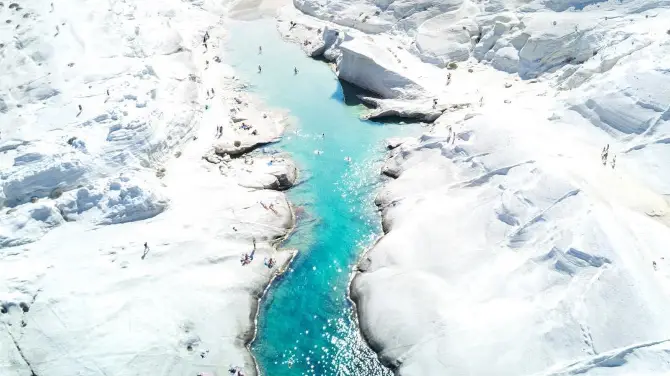
Sarakiniko is the reason people go to Milos. It is a stretch of smooth, white volcanic rock that erodes into arches and tidal pools, surrounded by electric blue water. It looks like a lunar landscape. It is completely free to enter—no ticket, no gate, no kiosk. Go at 8:00 AM. By 10:00 AM, the light is too harsh for photos, and the small coves fill up. Spend the afternoon in the main town, Plaka, which has a labyrinth of narrow streets and a cliffside castle ruins with a view that genuinely rivals Santorini—minus the €15 entrance fee and the crowd.
Day 2: The Secret Sea Caves
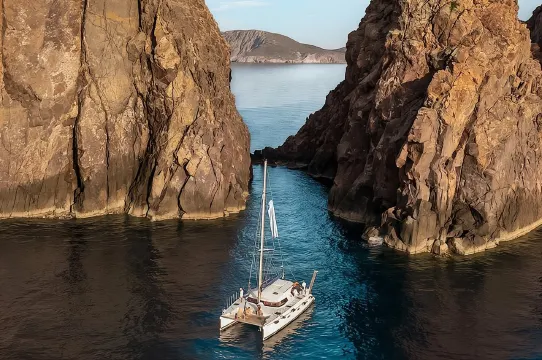
You cannot access the best parts of Milos by land. The island is sliced by fjord-like inlets and massive sea caves like Kleftiko, which was historically used by pirates to hide their ships. The water inside the caves is a glowing, translucent turquoise. This is the single most important day of the trip, and you need to book the right boat.
MORE WAYS TO SEE THE COAST
Day 3: Chasing the Sunset
Everyone in Santorini goes to Oia for the sunset. Everyone is miserable. In Milos, you take a 15-minute walk from Plaka to the top of the Prophet Elias chapel. There is no infrastructure. There are no vendors. There is just a small stone church and a 360-degree view of the entire island, the Aegean Sea, and the sun dropping below the horizon in total silence. That is what a Mediterranean sunset is supposed to feel like.
How to Actually Get to Milos
This is the only logistical hurdle, and it is the reason Milos remains uncrowded. There is no major international airport. You have two options for Summer 2026:
Option A (The Scenic Route): Fly to Athens. Take a 3.5-hour ferry from Piraeus to Adamas (the main port of Milos). This is comfortable if you book a VIP lounge seat via Trip.com, but it eats up half a day.
Option B (The Fast Route): Fly directly to Milos Island Airport (MLO) from Athens on Olympic Air. The flight is 45 minutes.
Where to Stay in Milos ($100–$150/Night)
This is where the Santorini math completely collapses. On Santorini, $150/night gets you a windowless studio 20 minutes from the caldera. On Milos, $100–$150 gets you a boutique sea-view room with a balcony, a short walk from the waterfront.
Don't Land Without Data: eSIM for Greece
There is nothing worse than landing in Athens, turning on your phone, and realizing your carrier charges $12/MB for international roaming. Buy an eSIM before you leave—it activates via QR code the moment you touch down. I tested two options for Greece and both work flawlessly on Milos (which has surprisingly good 4G/5G coverage for a small island).
My recommendation: if you're on Milos for 3–4 days and mainly need Google Maps, WhatsApp, and occasional browsing, the Day Pass eSIM at $0.09/day is absurdly cheap. If you're working remotely or posting heavily, get the Orange 20GB plan at $11.78—it includes actual calls and SMS, which matters if you need to contact your hotel or boat tour operator.