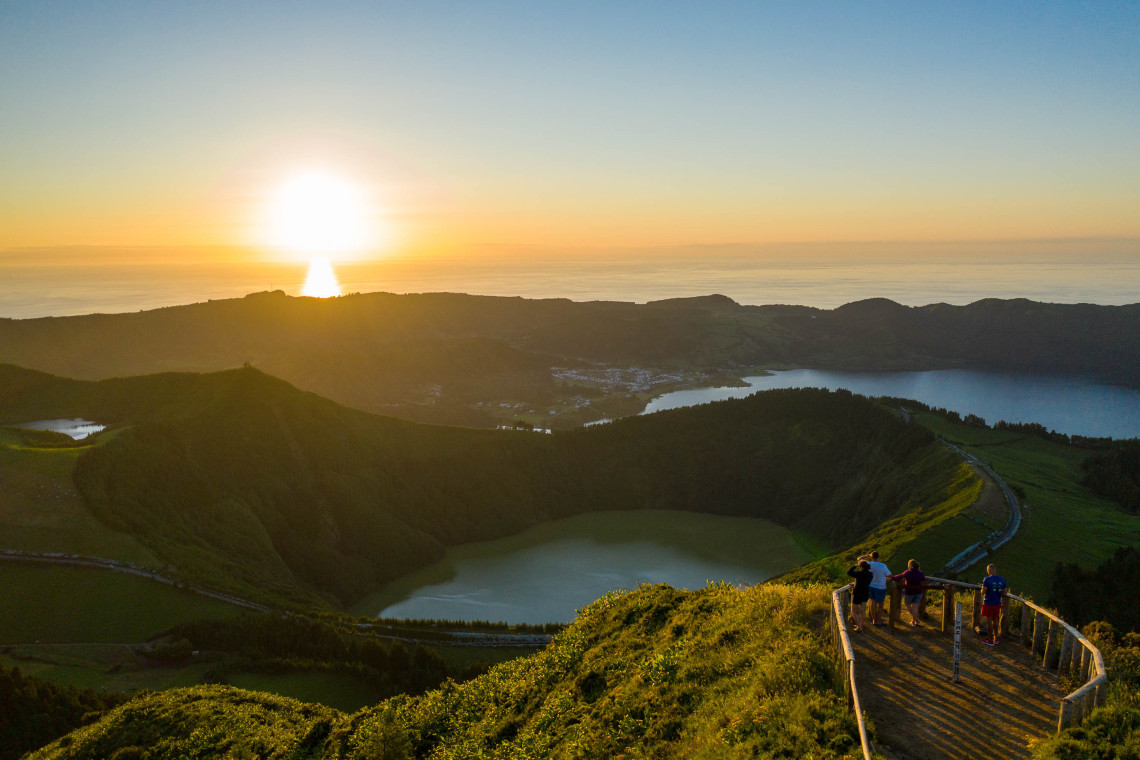
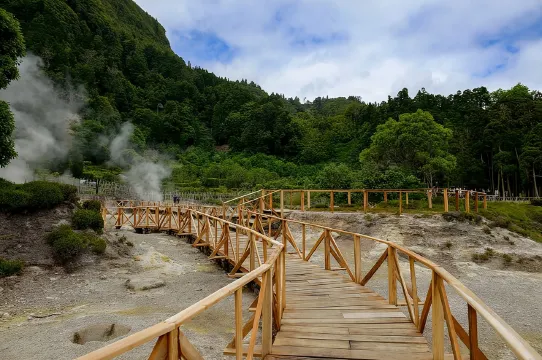
I was sitting in a hot spring on the side of a volcano, watching the steam curl up through trees that belonged in a Jurassic Park set, when I did the math. The flight that brought me here cost €297 return. The hot spring entry was €8. The lunch I'd had two hours earlier — grilled limpets, local cheese — came to €22 for two people. The entire day, including the rental car, had cost less than a single poolside cocktail at the Four Seasons Maui.
And the view was better.
The Azores is an archipelago of nine volcanic islands in the mid-Atlantic, roughly 1,500 kilometres west of Lisbon and 3,900 kilometres east of New York. It is, by any geological or aesthetic measure, the closest thing Europe has to Hawaii — volcanic craters filled with impossible lake colours, geothermal hot springs steaming out of hillsides, coastlines where whales pass so close you can hear them breathe from the clifftop path. The difference is that nobody has built a resort on it yet, and a week here costs roughly what three nights in Waikiki would.
The comparison is not lazy. The Azores and Hawaii sit at nearly identical latitudes — both around 37°N — and share a volcanic origin, a subtropical climate, and a startlingly similar landscape vocabulary. What they don't share is price, crowds, or the particular exhaustion that comes from navigating a destination that has been optimised for tourism revenue rather than human experience.
São Miguel: The Island That Shouldn't Exist
São Miguel is the largest island in the Azores, and the one you should visit first. It is roughly the size of Mallorca but with a population of just 140,000, which means the landscape dominates entirely — rolling green pastures bordered by hydrangea hedges, volcanic calderas that appear without warning around mountain bends, and a coastline that alternates between dramatic black lava cliffs and sheltered swimming coves with water you can actually swim in from June through October.
The island's two signature sights — Sete Cidades and Furnas — are the ones that will make the Hawaii comparison click into place. Sete Cidades is a massive volcanic caldera containing twin lakes, one naturally blue, one naturally green, separated by a narrow bridge and framed by walls of dense vegetation that rise 300 metres on either side. Stand at the Miradouro da Vista do Rei overlook on a clear morning and the resemblance to Kauai's Na Pali coast in mood — if not in exact geology — is striking. The difference is that you're sharing the viewpoint with three other people instead of a tour bus.

Furnas, on the island's eastern side, is where the volcanic activity becomes tangible. The ground here is hot. Literally. You can put your hand on the earth in certain spots and feel the heat rising through the soil. The town's thermal baths — particularly the iron-rich springs at Caldeiras da Furnas — are the sort of experience that in Hawaii would require a $300 spa reservation and a 48-hour booking window. In Furnas, you turn up, pay a few euros, and sit in water that the earth has heated for you.
The Cozido das Furnas — A Meal Cooked by the Earth
There is a dish in Furnas that exists nowhere else in the world, and it is worth the trip to São Miguel on its own. The cozido das Furnas is a traditional Portuguese stew — pork, beef, chicken, chorizo, cabbage, carrots, potatoes — slow-cooked for six to seven hours underground, using nothing but the volcanic heat emanating from fissures in the earth. The pots are lowered into the ground in the morning and pulled out at lunchtime, and the result is a meal so tender and deeply flavoured that it makes every slow-cooker you've ever owned feel like a toy.
Most local restaurants in Furnas serve it. Expect to pay €15–€20 per person for a full spread including bread and local cheese. The same quality of slow-cooked meat dish at a resort restaurant in Maui would be €45 minimum, and it would not have been cooked by a volcano.
The Whales — And Why This Beats Maui
Hawaii is famous for whale watching. Maui's Humpback Whale season draws hundreds of thousands of visitors between January and April, and the boats are large, the queues are long, and the experience, while genuine, has the texture of a well-managed event.
The Azores is arguably the best whale-watching destination in the Atlantic. The waters around São Miguel sit on a migratory corridor used by over twenty species of cetacean — sperm whales, fin whales, blue whales, sei whales, pilot whales, and several dolphin species. The season runs from April to October, and most operators report success rates above 95%.
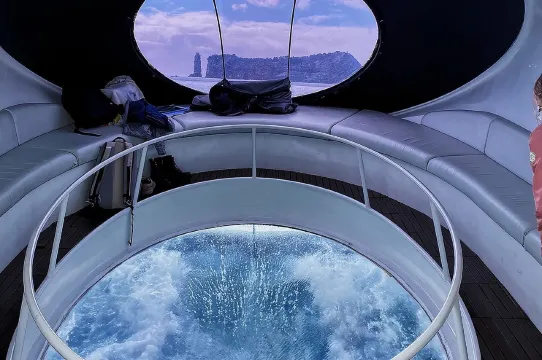
The difference in experience is structural. Azorean whale-watching operators work out of small rigid inflatable boats that carry eight to twelve people. There are no party boats, no 200-passenger catamarans with a bar. You are close to the water. When a sperm whale surfaces thirty metres from your boat, you hear it breathe before you see it. A three-hour trip from Ponta Delgada costs €55–€65. In Maui, the equivalent runs $120–$180.
Nordeste — The Side of the Island That Tourists Miss
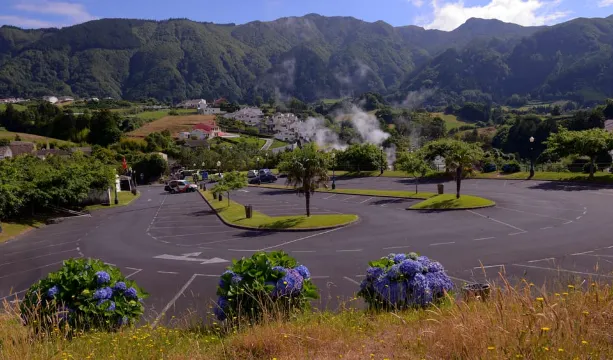
Most visitors to São Miguel drive the western loop — Sete Cidades, Mosteiros, the coastal road to Ginetes — and consider the island covered. The eastern half, dominated by the Nordeste municipality, is where the island becomes genuinely wild. This is the oldest geological part of São Miguel, and it looks it — the vegetation is denser, the cliffs are higher, and the roads wind through landscapes that feel untouched by the last century, let alone the last decade.
Nordeste has the island's highest coastal viewpoints, including the Miradouro da Ponta do Sossego and Miradouro da Ponta da Madrugada, where on a clear morning you can see both the northern and southern coastlines simultaneously. The region also has waterfalls (Ribeira dos Caldeirões is the most accessible), natural swimming pools carved into volcanic rock at Ponta do Sossego, and hot springs at Ribeira Quente that are less commercialised than Furnas. You can drive the entire Nordeste coast in a long afternoon, stopping at viewpoints and waterfalls, and see perhaps six other cars the entire time.
Getting There for €300 — And Why Most People Don't Know You Can
This is the part that still surprises people, and it shouldn't. SATA Airways — the Azores' flag carrier — operates direct flights from Ponta Delgada to Lisbon, Porto, London, Frankfurt, Paris, Amsterdam, and several other European hubs. Ryanair has also added seasonal routes from the UK and Ireland. In 2025 and 2026, the route network has expanded further, with new direct connections from Barcelona and Milan.
The fares are not an anomaly. Return flights from London to Ponta Delgada routinely appear between €180 and €320 if you book six to eight weeks ahead. From Lisbon, it's €60–€120 return. These are not error fares — this is simply what it costs to fly to a mid-Atlantic island that most European travellers haven't thought to visit. Compare this to Hawaii: from London, the cheapest return to Honolulu is typically €700–€1,100, with an 11-hour time difference and two full days lost to jet lag. The Azores is on GMT. You land, drive thirty minutes, and you're standing at the edge of a volcanic crater.
Car Hire: Non-Negotiable
São Miguel has a public bus system. It is slow, infrequent, and does not go to the places you want to see. You need a car. The good news is that car hire on São Miguel is cheap by European standards — expect to pay €25–€40 per day for a compact car, and the entire island can be driven end-to-end in about ninety minutes. The roads are well-maintained, largely empty, and occasionally spectacular enough that you will pull over simply to process what you're looking at.
Where to Stay — Without Overpaying
São Miguel's accommodation scene is evolving. There are now several genuinely excellent boutique hotels on the island, alongside a large inventory of local guesthouses and self-catering apartments that represent extraordinary value.
For a luxury experience at a fraction of Hawaii prices, the Furnas Boutique Hotel — with its thermal pools and forest setting — is the standout. Rates in summer are €140–€200 per night. The equivalent experience at a thermal resort in Hawaii would cost three to four times that.
For value without compromise, the self-catering apartments around Ponta Delgada and Ribeira Grande on the island's north coast are the move. A modern one-bedroom apartment with an ocean view, fully equipped kitchen, and parking costs €50–€80 per night. The kitchen matters here — the island's markets sell excellent local produce and cheese at prices that make cooking in a genuine pleasure rather than a budget constraint.
Don't Land Without Data: eSIM for the Azores
The Azores is an EU territory, which means your regular EU roaming plan technically works. But "technically works" and "actually works" are different things on a volcanic island in the middle of the Atlantic. Coverage outside Ponta Delgada and Ribeira Grande is patchy. SATA's in-flight Wi-Fi is expensive. And if you're driving to Nordeste or Sete Cidades, you will want Google Maps to work without buffering.
Buy an eSIM before you leave. It activates via QR code the moment you land, and it means you have data immediately — no hunting for a local SIM kiosk at PDL, no dealing with Portuguese carrier signup pages in a language you don't read.
For a 7-day Azores trip, the Day Pass eSIM at $0.09/day is absurdly cheap if you mainly need Maps, WhatsApp, and occasional browsing. If you're posting heavily or working remotely from your apartment, get the Orange 20GB plan at $11.78 — it includes actual calls and SMS, which matters if you need to call your whale watching operator to confirm departure.
The Honest Part: What the Azores Isn't
The Azores is not Hawaii, and pretending otherwise would be dishonest. It does not have Hawaii's consistently warm ocean water — the Atlantic here is 19–22°C in summer, which is swimmable but not bathwater. It does not have Hawaii's resort infrastructure — there is no Four Seasons, no branded luxury spa, no beachfront cocktail bar with a DJ. The weather is genuinely unpredictable; you can experience four seasons in a single afternoon on São Miguel, and the famous Atlantic fog can roll in and erase a crater view in minutes.
The beaches are not tropical. They are dramatic, volcanic, and beautiful in a way that is fundamentally different from white sand and palm trees. The nightlife is minimal. The dining scene, while excellent for what it is, operates on a small-island rhythm where reservations matter and kitchens close early.
These are not flaws. They are the conditions that keep the Azores what it is — a place that feels like a discovery rather than a product. If you need guaranteed sunshine, 27°C water, and a poolside cocktail menu, go to Hawaii. But if you want to stand on the rim of a volcanic crater in the morning, swim in a thermal spring at midday, watch a sperm whale surface in the afternoon, and eat a meal cooked by the earth in the evening — all for less than the cost of a single night at a Hawaiian resort — the Azores is not just an alternative. It is a better trip.
The Cost Breakdown Nobody Shows You
The Azores costs roughly one-third of an equivalent Hawaii trip. The experiences are directly comparable. The flight time from Europe is shorter. There is no jet lag. And you are in the EU, which means your phone works, your health insurance covers you, and you don't need to fill out an ESTA form.
Disclosure: These are affiliate links. We earn a small commission at no extra cost to you.