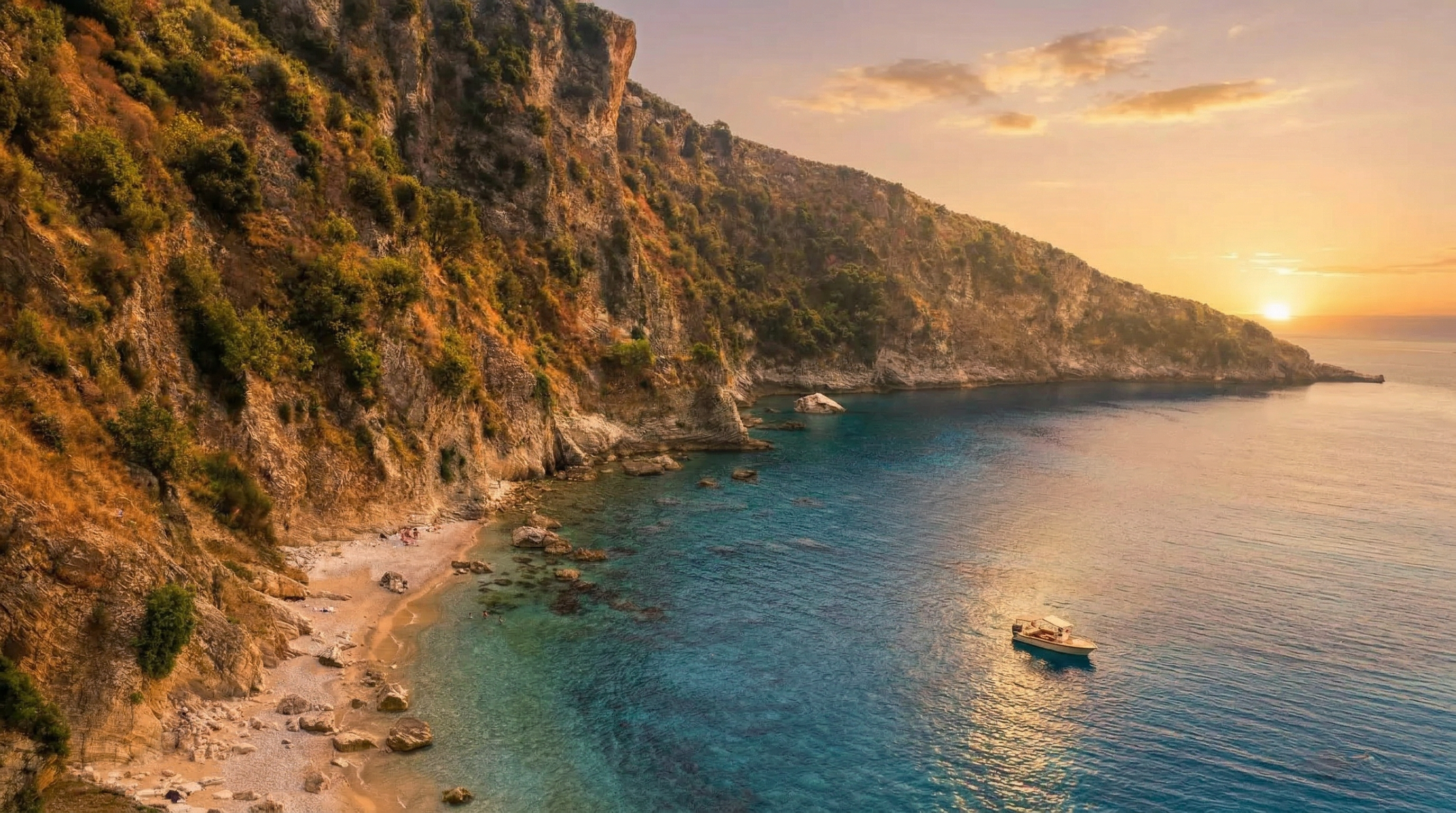
There is a moment, somewhere on the road between Sarandë and Himara, where the Albanian Riviera reveals itself without warning. You come out of a mountain curve and the Ionian Sea is suddenly below you — an impossible shade of blue-green that coastal Italy charges €400 a night for you to look at — and the road is empty, and there is no coach party behind you, and the village below has maybe forty houses and one taverna, and your lunch is going to cost €6.
That moment is why you go to Albania.
The Albanian Riviera is not a secret kept by travel insiders. It is a secret kept by geography, by history, and by the fact that until recently, most Western Europeans hadn't thought to look this far southeast for a Mediterranean summer. That is changing — slowly, and then, if recent trends are any indication, very quickly. The Amalfi Coast was "undiscovered" once. So was Dubrovnik. So was the entire island of Mykonos. Before the cruise ships and the three-hour queues and the €28 spritzes, someone was sitting on those cliffs thinking: nobody knows about this yet.
That person is you, right now, in Albania. Summer 2026. Get here.
The Stretch That Changes Everything
The Albanian Riviera runs roughly 150 kilometres from Vlorë in the north down to Sarandë at the southern tip, where Albania nearly touches Corfu. The entire coast is defined by the Ceraunian Mountains — a range that plunges directly into the Ionian Sea with a dramatics that rivals anything in the western Mediterranean. The result is a coastline of hidden coves, remote beaches accessible only by boat or goat track, and small towns clinging to cliffs in a way that feels genuinely, structurally timeless.
The two towns that matter most are Himara and Ksamil, and they couldn't be more different from each other. Himara is the one that feels like a secret: an old castle town on a hillside above a quiet bay, with a handful of excellent restaurants, several boutique guesthouses, and a beach that stretches south without a sun lounger in sight for the first kilometre. In high summer, it gets busy — but "busy" here means you might share your cove with four other people rather than one.
Ksamil, to the south, is the one that has started to escape the algorithm. Small islands sit just offshore in water so clear that you can see the bottom from ten metres up on the cliff road. It is, not to overstate it, one of the most visually extraordinary places in Europe. The comparison to the Maldives, which you will find on approximately every Albanian tourism poster, is for once not entirely undeserved.
Where to Stay
This is where the Albanian Riviera genuinely defies comparison. For the price of a corridor-facing room in a budget Positano hotel — call it €150 a night — you can book a sea-view room in one of Himara's small boutique guesthouses, built by local families who know the coast the way only people who grew up on it can. Breakfast will be included. It will involve figs from a tree twenty metres away and olive oil pressed locally and cheese you will not be able to identify but will want immediately replicated at home.
In Ksamil, online booking platforms' inventory has expanded significantly over the last two years — a reliable sign that infrastructure is catching up to demand without yet overwhelming the character of the place. The properties worth your attention are the smaller, family-run ones set slightly back from the main beach. They're quieter, the hosts are extraordinary, and the difference in price versus the newer "resort-style" options is negligible.
Getting There Without Losing a Day
Flying into Tirana (TIA) is the standard entry point, and the options have expanded meaningfully since 2024. Budget airlines now serve Tirana from a growing number of European hubs, and return fares from London, Paris, or Rome routinely come in under €120 if you book six to eight weeks out. The flight itself is two to two-and-a-half hours from most of western Europe — shorter than flying to Lisbon, considerably shorter than flying to Athens.
From Tirana, the drive south to the Riviera takes three to four hours depending on your first stop. Renting a car is by far the best option — the coastal road itself is reason enough to drive, and public transport to the more remote coves simply doesn't exist. International car hire platforms have full coverage at Tirana airport, and rates are substantially lower than equivalent bookings in Italy or Greece.
There is also a ferry option from Corfu to Sarandë that takes forty-five minutes and runs several times daily in summer — useful if you're combining Albania with the Greek islands, which I'd argue is the ideal two-week itinerary in this part of the world.
The Food and the Reason You'll Stay an Extra Week
Albanian cuisine operates on a simple and deeply satisfying principle: take exceptional local ingredients, apply minimal interference, and serve them with a view. The mezze tradition here is strong — a table of small plates arrives before you've finished asking what's available, and it tends to include fermented olives, local cheeses, grilled peppers in olive oil, and bread that was in an oven ninety minutes ago.
The seafood is the thing. Grilled fresh fish on the Albanian Riviera — squid, sea bream, octopus — costs somewhere between €8 and €14 for a main course. Order the same fish at the same quality level on the Amalfi Coast and budget €35 to €50. The Albanian version will taste better, not because of some romanticised idea of authenticity, but because the supply chain between sea and plate is measured in hours, not days.
A Note on Money
Albania uses the Albanian Lek. While cards are increasingly accepted in hotels and larger restaurants, cash still rules in smaller towns and at beach bars. The important thing to know is that standard bank card fees will erode your budget — many UK and European banks charge 2–3% on foreign currency transactions, which adds up across a week. A dedicated travel debit card eliminates this entirely, converting at the mid-market rate with no hidden fees. It's the single most practical upgrade you can make before any non-euro destination in the Balkans. We cover this in full in our Albanian currency guide, including the exact cards that work best.
For a more detailed breakdown of costs and how to plan your trip, check out our Albania itinerary — it includes a day-by-day guide to the Riviera, as well as practical advice on getting around and finding the best value accommodation.
The Honest Part: What Albania Isn't Yet
The Albanian Riviera in 2026 is not the Amalfi Coast. The roads are occasionally rough. The signage is inconsistent. Customer service varies wildly between the excellent and the indifferent. A small number of beaches near the more popular towns have accumulated litter that the infrastructure hasn't yet caught up to managing. There are places where the construction of new hotels is proceeding at a pace that doesn't quite match the surrounding landscape.
None of this is disqualifying. It is, in fact, exactly the condition that the Amalfi Coast and Dubrovnik were in before they became what they are now. The difference is that you're here before that transition completes — and that difference is worth several hundred euros a night and an experience that still feels genuinely unscripted.
The Albanian government has been investing heavily in the southern coastal road and the hospitality infrastructure around Himara and Ksamil since 2023. EU candidate status has accelerated this. The trajectory is clear. The question is only whether you'd rather be here for this chapter, or the next one — when the prices have caught up and the boutique hotels have been bought by international groups and the Instagram accounts have found the good beaches.