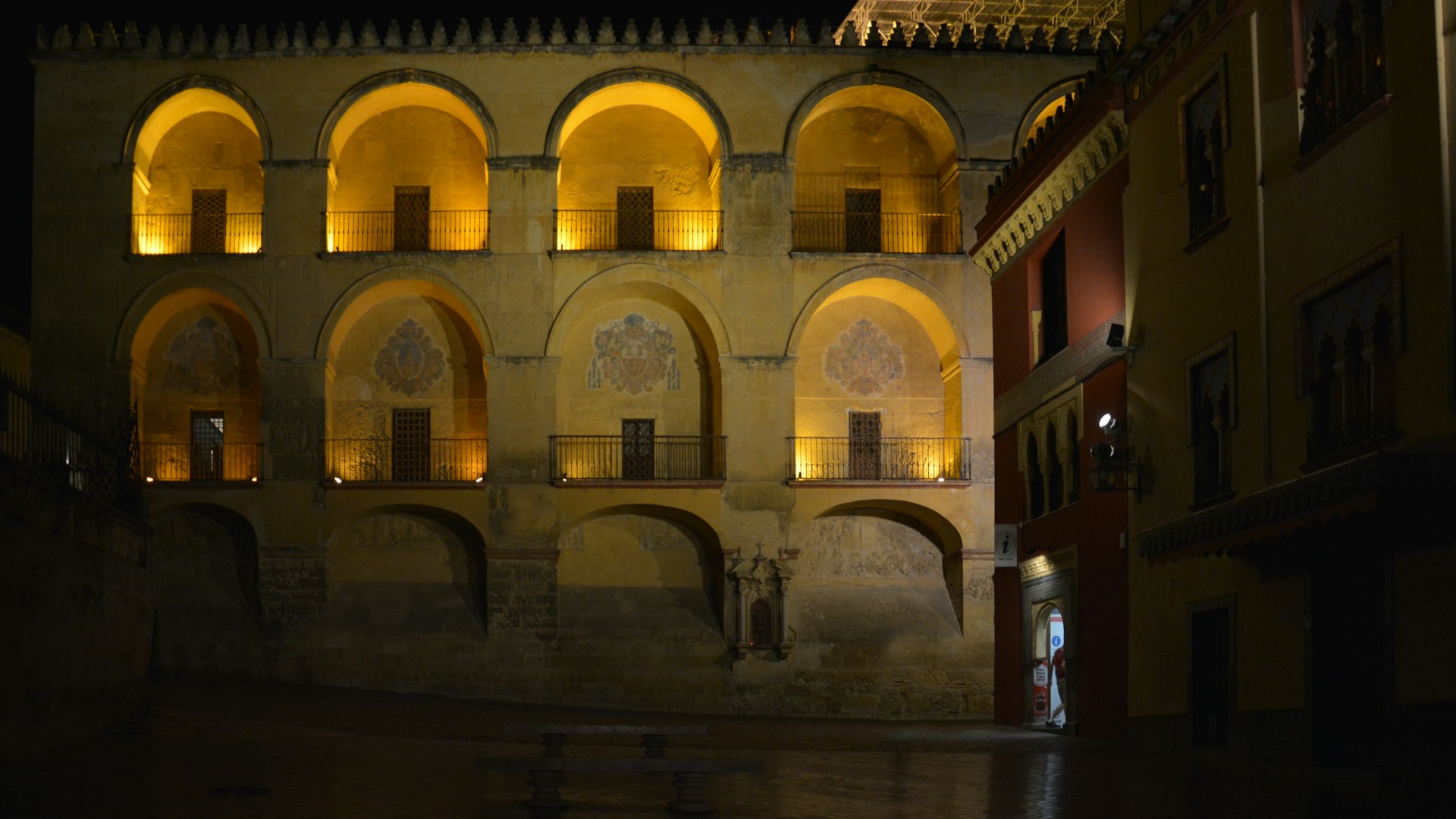
At its medieval peak, Córdoba was the largest city in western Europe — the capital of Al-Andalus, a civilisation that preserved ancient Greek philosophy while Europe was in its Dark Ages, and the home of the Mezquita: a great mosque of such scale and beauty that even after the Reconquista, the conquering Christians couldn't bring themselves to destroy it. They built a cathedral inside it instead, creating one of the strangest and most magnificent buildings in the world.
Córdoba is also the hottest city in Spain. In July and August temperatures regularly hit 42°C. Visit in spring or autumn. The city is compact, the old town can be walked in an hour, and a single intense day is enough to cover the main sights — but two days lets you breathe.
The Mezquita-Catedral
Tickets, how to avoid queues, and when to visit
The Mezquita-Catedral (€13 adults, free under-10) is among the most extraordinary buildings in Europe. Construction began in 784 CE under Abd al-Rahman I, who built a mosque on the site of a Visigoth church using repurposed Roman columns. His successors expanded it three times over the following two centuries until it became the second-largest mosque in the world. In 1236 Ferdinand III of Castile took Córdoba and converted the mosque to a cathedral — and in the 16th century, a full Renaissance nave was inserted into the centre of the prayer hall.
What remains is architecturally incoherent in the best possible way: 856 ancient columns with red-and-white striped arches stretching in every direction, a gilded Islamic mihrab (prayer niche) of extraordinary craftsmanship, and a fully functioning Catholic cathedral inserted into the centre like a ship in a bottle. The Catholic bishop at the time famously said to Charles V: "You have destroyed something unique to build something ordinary." Charles reportedly agreed.
Free early entry: Monday to Saturday from 08:00–09:30, admission is free. This is the single best strategy for visiting — you get the building with almost no crowds and in the best light. Join the queue at the main entrance at 07:50. The free period fills up fast by 08:30.
If visiting during paid hours, book online in advance to avoid 40-minute queues in summer. The nighttime tours (€18, Tuesday–Saturday from June to October) illuminate the building dramatically and attract far fewer visitors than daytime sessions.
Daily Costs 2026
One of Andalusia's most affordable cities
| Item | Cost (2026) |
|---|---|
| Budget hostel / guesthouse | €20–45 |
| Mid-range hotel | €60–90 |
| Mezquita-Catedral | €13 (free Mon–Sat 08:00–09:30) |
| Alcázar de los Reyes Cristianos | €5 (free Sunday) |
| Medina Azahara (site + museum) | €6 (free for EU citizens) |
| Lunch menú del día | €9–12 |
| Tapas dinner (3–4 bars) | €12–18 |
| Budget daily total (guesthouse, free Mezquita, tapas) | €45–60 |
Things to Do in Córdoba
Beyond the Mezquita
Alcázar de los Reyes Cristianos (€5, free Sunday). The fortress-palace built by Alfonso XI in 1328 on the site of an earlier Moorish palace, with a series of beautifully maintained formal gardens running along the river. Christopher Columbus met Isabella I here before his first Atlantic voyage. Allow 90 minutes for the building and the gardens.
Jewish Quarter (Judería, free to walk). The medieval Jewish neighbourhood northwest of the Mezquita is one of the best preserved in Spain — whitewashed walls, flower-lined narrow streets, the 14th-century Synagogue (€0.30 entry, one of only three surviving medieval synagogues in Spain), and the Maimonides statue. Free to explore; the streets themselves are a highlight.
Medina Azahara (€6, free for EU citizens). The ruins of a 10th-century palace-city built by Abd al-Rahman III — once one of the most magnificent palaces in the world, covering 112 hectares and housing 40,000 people. Destroyed in 1010, rediscovered in 1910, still being excavated. Located 8km west of the city; take the official tourist bus (€3 return from Glorieta Ibn Rushd) rather than a taxi. Allow 2 hours.
Festival de los Patios (May, free). In May, private homeowners open their inner courtyards to the public in a competition that has been running since 1921. The courtyards are explosions of flowers — geraniums, jasmine, bougainvillea — cascading from walls and balconies. Free to visit; maps available from the tourist office. One of the most beautiful experiences in Andalusia.
Food Scene
Salmorejo, rabo de toro, and local tabernas
Salmorejo is Córdoba's signature dish — a thick, cold tomato soup topped with serrano ham and hard-boiled egg. Unlike the thinner Sevillian gazpacho, salmorejo is almost paste-like in consistency. Try it at Taberna Salinas (Calle Tundidores 3, one of Córdoba's oldest taverns, open since 1879) or at almost any restaurant in the old town.
Rabo de toro (bull's tail stew) is the other Córdoba speciality — a slow-braised oxtail with vegetables and wine that needs hours to cook properly. The best version is at Casa Pepe de la Judería in the Jewish Quarter or at Taberna San Miguel (Taberna El Pisto).
The streets surrounding the Mezquita are tourist traps. Walk five minutes north into the Judería or toward the Mercado Victoria covered market for much better value: €9–12 menús del día that locals actually eat, not €25 set menus designed for coach tours.
Day Trips from Córdoba
Seville, Granada, and the Subbética
Seville (45 minutes by high-speed AVE, €12–25). Seville is the nearest major city — frequent high-speed trains make it a comfortable half-day. See the Seville guide for details.
Granada (1.5 hours by bus or train). The Alhambra, Generalife, and the Albaicín quarter are 90 minutes from Córdoba. Book Alhambra tickets weeks in advance.
Priego de Córdoba. A small baroque city 80km south of Córdoba, known as the "Capital of Córdoba Baroque" for its ornate 18th-century churches. Also has a spectacular natural setting at the edge of the Subbética mountain range and some of the best olive oil in Andalusia. Worth a half-day for architecture and food enthusiasts.
Practical Tips
Getting there, when to visit, what to avoid
Getting there: Córdoba station has excellent AVE (high-speed) rail connections — 45 minutes from Seville (€12–25), 2 hours from Madrid (€25–45), and on the main Madrid–Málaga AVE line. No airport; fly to Seville (SVQ) or Málaga (AGP) and take the train.
When to visit: March, April, May and October are ideal. Córdoba is regularly the hottest city in Spain in summer — 40–42°C in July and August, making sightseeing genuinely difficult. Spring and autumn mean 20–28°C and manageable crowds. The Patios Festival in May is a highlight if you can time your visit.
Getting around: The historic centre is entirely walkable — Mezquita, Judería, Alcázar, and the main squares are within 15 minutes of each other on foot. For Medina Azahara, take the tourist bus from Glorieta Ibn Rushd (€3 return, departs approximately hourly).
Disclosure: Tour links are affiliate links. We earn a small commission at no extra cost to you.
Disclosure: These are affiliate links. We earn a small commission at no extra cost to you.
FAQ
Common questions about Córdoba 2026
How much does the Córdoba Mezquita cost in 2026?
€13 adults, free for children under 10. Free for everyone Monday to Saturday 08:00–09:30 — the best time to visit for both avoiding crowds and saving money. Book online if visiting during paid hours to skip queues.
How many days do you need in Córdoba?
One full day covers the Mezquita, Jewish Quarter, and Alcázar. Two days is more relaxed and allows for Medina Azahara in the afternoon. Córdoba is often visited as a day trip from Seville or Málaga — both cities are under 1 hour away by AVE.
When is the best time to visit Córdoba?
Spring (March–May) is ideal — the Patios Festival runs in May. Autumn (September–October) is also excellent. Avoid July and August: Córdoba regularly hits 42°C and the heat makes sightseeing difficult. December–February is quiet, mild, and cheap.
What is Córdoba's most famous food?
Salmorejo — a thick cold tomato soup with jamón and egg — is the city's defining dish. Rabo de toro (slow-braised bull's tail stew) is the other speciality. Both are found at every traditional taberna in the historic centre.