The Short Answer
Both are excellent value compared to the Cyclades — you'll pay roughly half what Santorini or Mykonos charge for similar quality. Between the two: Crete wins on food, variety, and depth (it's a country pretending to be an island); Rhodes wins on compactness, the Old Town, and ease for a first-timer. If you have a week and a rental car, Crete. If you have 4–5 days and want everything close together, Rhodes.
Real 2026 Costs, Side by Side
Accommodation (per night, mid-range, July–August): Crete €55–110 depending on region (cheaper in the west and the south coast, pricier in Chania old town and Elounda). Rhodes €60–120, with Rhodes Town and Lindos at the top end. Both drop 30–40% in June and September.
Food: This is where Crete pulls ahead. A taverna meal in a Cretan village runs €12–18 per person, and the island's agricultural wealth means the produce, cheese, olive oil, and meat are exceptional. Rhodes is still cheap by European standards (€14–22 a meal) but leans more touristy near the resorts, so you work a little harder to find the honest places.
Getting around: Rhodes wins here. It's compact (a car is useful but not essential near Rhodes Town), and the road network is simple. Crete is huge — 260km end to end — so a rental car (€25–40/day in season) is effectively mandatory to see more than one base, and inter-city drives eat real time.
Daily budget (mid-range, with a car where needed): Crete €70–100/person; Rhodes €65–95/person. Both are roughly half a comparable Cyclades day.
Crete: The Island That's Really a Country
Crete is the largest Greek island and it feels like it — four distinct regions, the White Mountains, the Samaria Gorge, the pink sand of Elafonissi, Venetian harbours in Chania and Rethymno, the Minoan ruins at Knossos, and a south coast (Loutro, Plakias, Agia Roumeli) that still feels genuinely remote. The food culture is the best in Greece, full stop, and the Cretan diet is a real draw.
The trade-off is that Crete rewards time and a car. A long weekend barely scratches one corner. Plan a week minimum, pick one or two bases (Chania in the west is the most-loved), and accept that you'll drive.
Rhodes: Compact, Historic, Easy
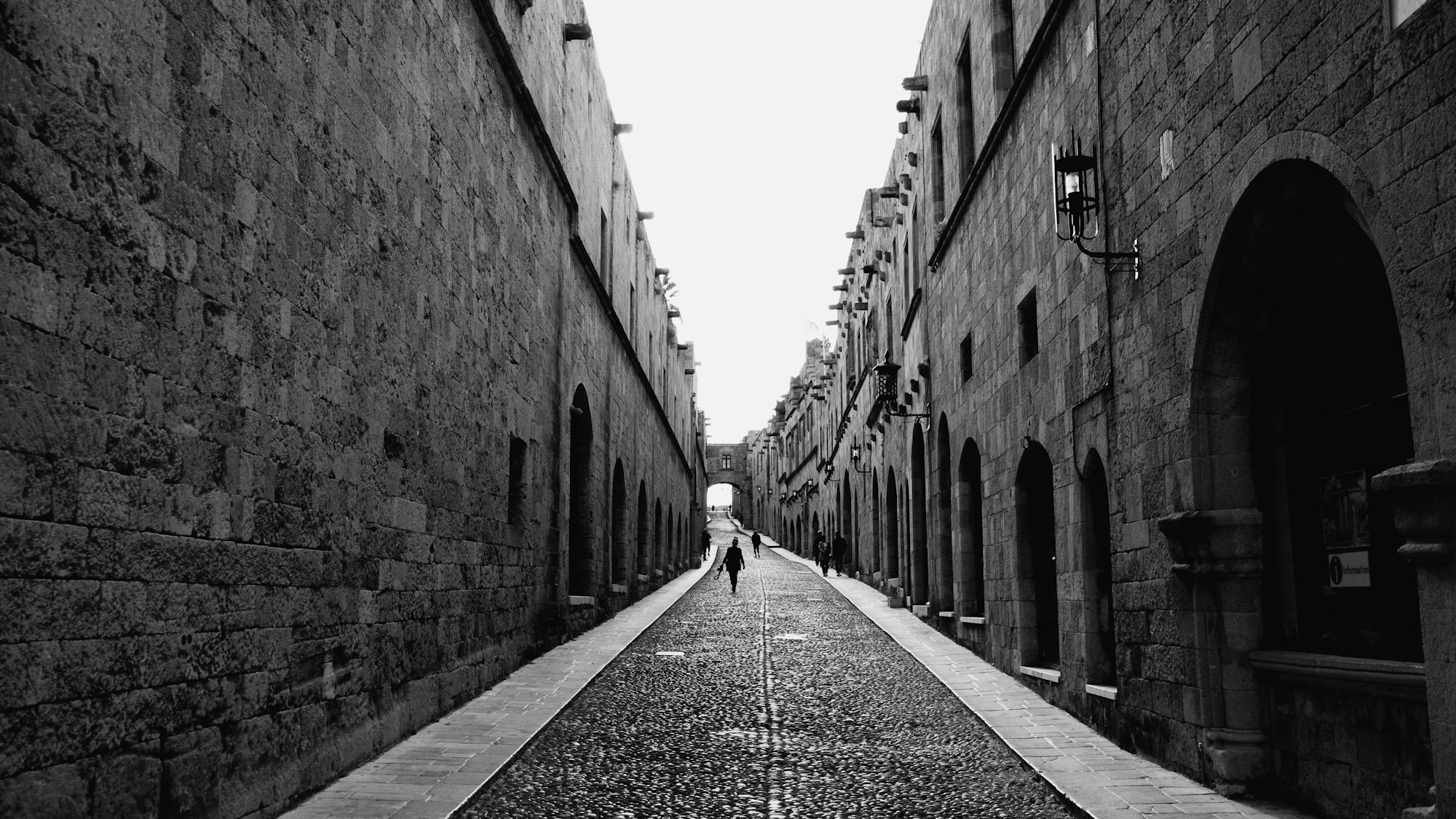
Rhodes packs an enormous amount into a smaller, more navigable island. The medieval Old Town — a fully walled, lived-in UNESCO site — is the most impressive in the Aegean, and there's nothing comparable on Crete. Lindos (whitewashed village under an ancient acropolis), the east-coast beaches, and the Valley of the Butterflies are all within easy reach. It's the easier island for a first Greek trip or a shorter stay, and the airport has more direct European connections in summer.
The downside: the east coast is heavily developed with package resorts, so the "authentic" Rhodes takes a bit more seeking out than rural Crete, where it's the default.
The "Remote Work" Factor
If you're staying a month or working remotely, Crete is the stronger base: better year-round infrastructure, two real cities (Heraklion and Chania) with coworking, reliable fibre in the towns, and a large enough local economy that life doesn't shut down out of season. Rhodes is more seasonal — wonderful May–October, quieter and more shuttered in winter. Both have solid 4G/5G along the coasts.
The Verdict
Choose Crete if: you have 7+ days, you'll rent a car, you care about food, or you want depth and variety. Choose Rhodes if: you have 4–5 days, you want everything close, you love history and walled old towns, or it's your first Greek island and you want it easy. Either way you're getting Cyclades looks at roughly half the price — the real "loss" is only ever Santorini's.